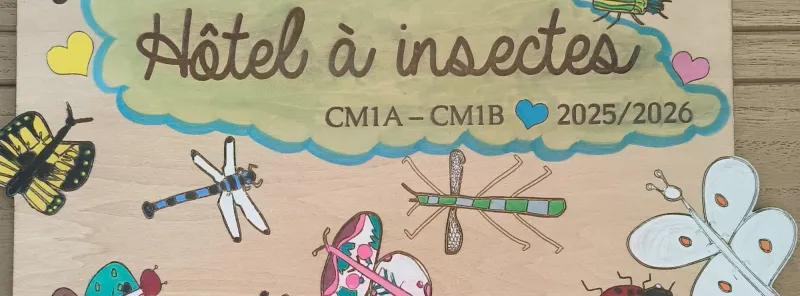
An insect hotel signed by two Year 5 classes
An insect hotel without a sign is a pile of drilled logs nobody notices. With a sign, it becomes a place people look at, point out and talk about.
So when Ambroise Paré school, a few streets from my workshop, told me about their project with the LPO, France's bird protection league, the question was never whether there should be a sign. It was what to put on it. The answer was obvious: the pupils themselves.
Through the 2025/2026 school year, the two Year 5 classes observed insects and drew them. I took care of what came next.
Thirty drawings, none left out
I set myself one rule from the start: no drawing would be dropped. Ladybirds, dragonflies, butterflies, bees and beetles, everything is on the panel, with no sorting and no ranking.
That is what gives the whole thing its cheerful density. Above all, it means every child can find their own, and that was non-negotiable for me.
Respecting the line without correcting it
Reproducing a child's drawing has nothing to do with reproducing a logo. A clean, closed outline cuts without argument. A pupil's line stops, overlaps, and leaves gaps exactly where the material would need to hold together.
My whole job is to respect that line without improving it. The temptation to straighten a symmetry, even out a pair of wings or recentre an antenna is strong. I have learned to resist it: giving in would miss the point. What makes this panel endearing is that you can recognise each child's hand.
My job was not to make beautiful insects, but exactly the ones the pupils had drawn.
Thirty insects painted by hand
Once the engraving came off the machine, everything was still the colour of raw wood. I painted every insect by hand, one at a time. It is by far the longest part of the project.
I work alone in the workshop, so a series like this happens over several days, brushstroke after brushstroke. A ladybird takes little time; a butterfly with patterned wings takes far longer. The cloud behind the title, fading from green to yellow, was redone several times before the shade satisfied me.
It is time you never really charge for. But watching the insects come back to life one by one is exactly why I do this work.
Why insects
When nature conservation is explained to children, birds and hedgehogs come first, the animals with a gaze. Insects rarely lead, even though everything else rests on them: no pollination, no birds, no gardens.
Drawing them forces real observation. How many legs, where the wings attach, what the antennae look like. A child who has drawn a bee no longer mistakes it for a wasp. And once the sign is up on the insect hotel, the observing carries on for real.
Wood rather than paper
A pinned-up drawing ends up faded at the bottom of a folder. The same shape engraved in wood goes outside, survives the seasons, and will still be there next year for the pupils arriving. It changes status: it becomes part of the playground, not homework.
The finished panel
Here it is, ready to be installed. Hanging from its cord, topped with a sunflower, with its thirty-odd residents.
A project within walking distance
The school and my workshop are in the same town. This kind of collaboration needs no complicated logistics: drawings collected by hand, a few trips back and forth, a finished panel brought back.
It is probably the simplest way to show pupils that a craft trade exists just down the road, practised by someone they can actually meet.
Have a similar project in mind?
If you are a teacher, a youth worker or run an association, write to me, I would be glad to talk it through. The principle transfers easily: signage for a teaching garden, panels along a nature trail, classroom door signs, or a collective cut-out wooden mural.